
Sourdough Ciabatta Rolls


Looking for simple sourdough ciabatta rolls to make from scratch? Just like our other beginner sourdough recipes, this one is as easy as it gets!
Not only does ciabatta bread make delicious sandwich buns, they are perfect alongside classic pot roast or for dipping in warm bowls of chicken noodle soup.
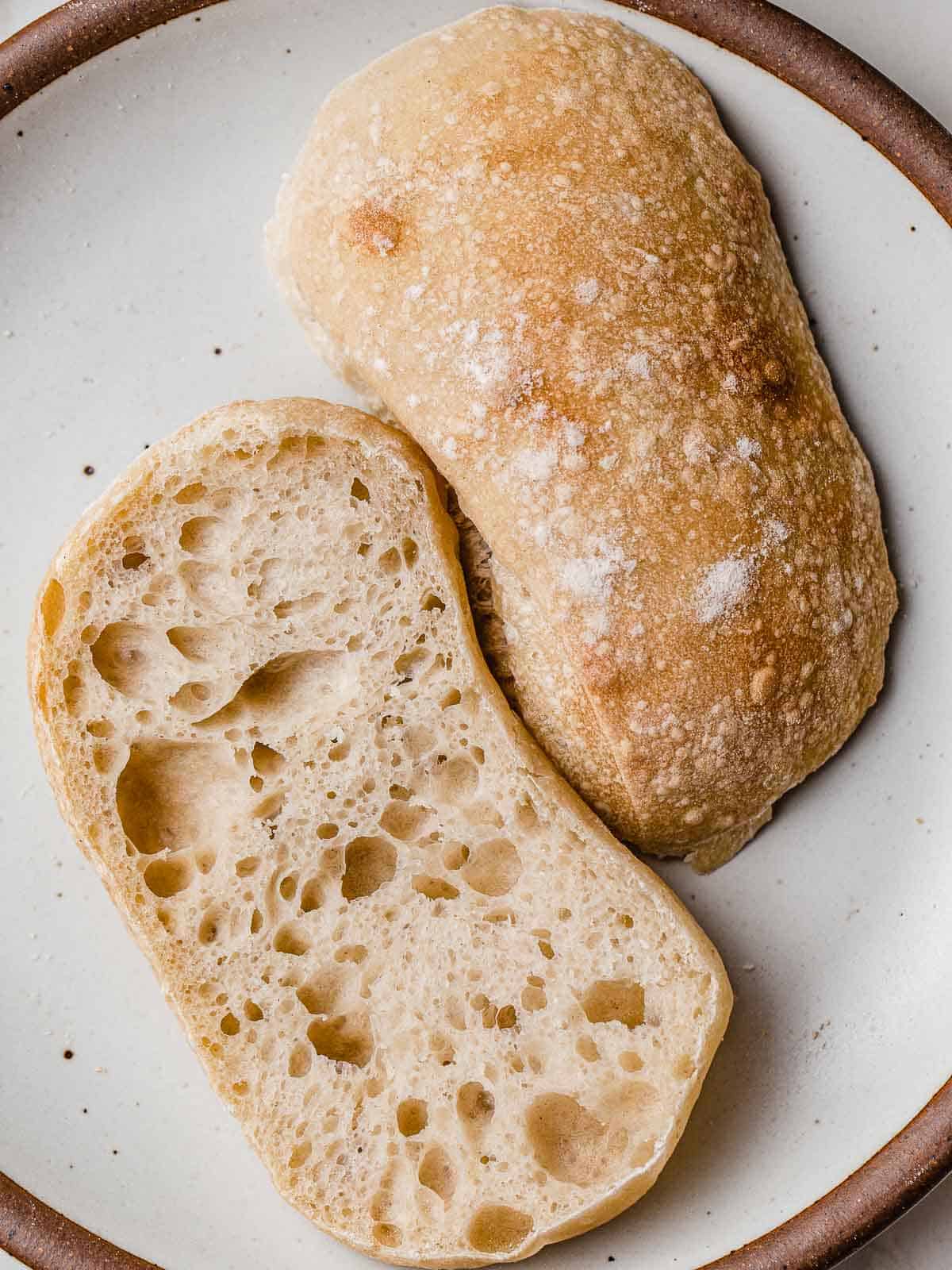
You're going to LOVE this recipe for sourdough ciabatta rolls because of its simplicity. Seriously, it really doesn't get easier than this.
Whether you would like to mix the dough and bake the same day or allow for a long proof in the fridge, we've made an easy to follow baking timeline that you can adjust to fit your schedule.
The ciabatta rolls bake right on a baking sheet in 30 minutes, making them perfect for enjoying with dinner. We love to serve them with broccoli cheese soup, white chicken chili verde or even turn them into gourmet grilled cheese sandwiches.
What you need
The ingredients needed for this recipe are very few.
- sourdough starter
- organic bread flour - all-purpose flour can be used, but will result in a smaller crumb instead of a large, open crumb.
- salt
- water
Equipment needed
(Amazon affiliate links) - Check out my favorite kitchen essentials.
Sample baking schedule
I love sharing my baking schedule with you so that you can easily adjust your rise times according to the temperature of your kitchen. Kitchen temperatures vary all year long depending on the climate, so always keep it in mind when baking with sourdough.
The night before
7:00 PM - Feed your sourdough starter.
TIP: Feed your sourdough starter so that it is active and bubbly when it's time to mix the dough. Depending on the maturity of your starter and the temperature of your kitchen, this can take anywhere from 4-12 hours.
The next morning
7:00 AM - Mix the dough, cover and allow it to rest 1 hour at room temperature.
8:00 AM - Perform the first set of stretches and folds. Cover and rest 30 minutes at room temperature.
8:30 AM - Perform the second set of stretches and folds. Cover and rest 30 minutes at room temperature.
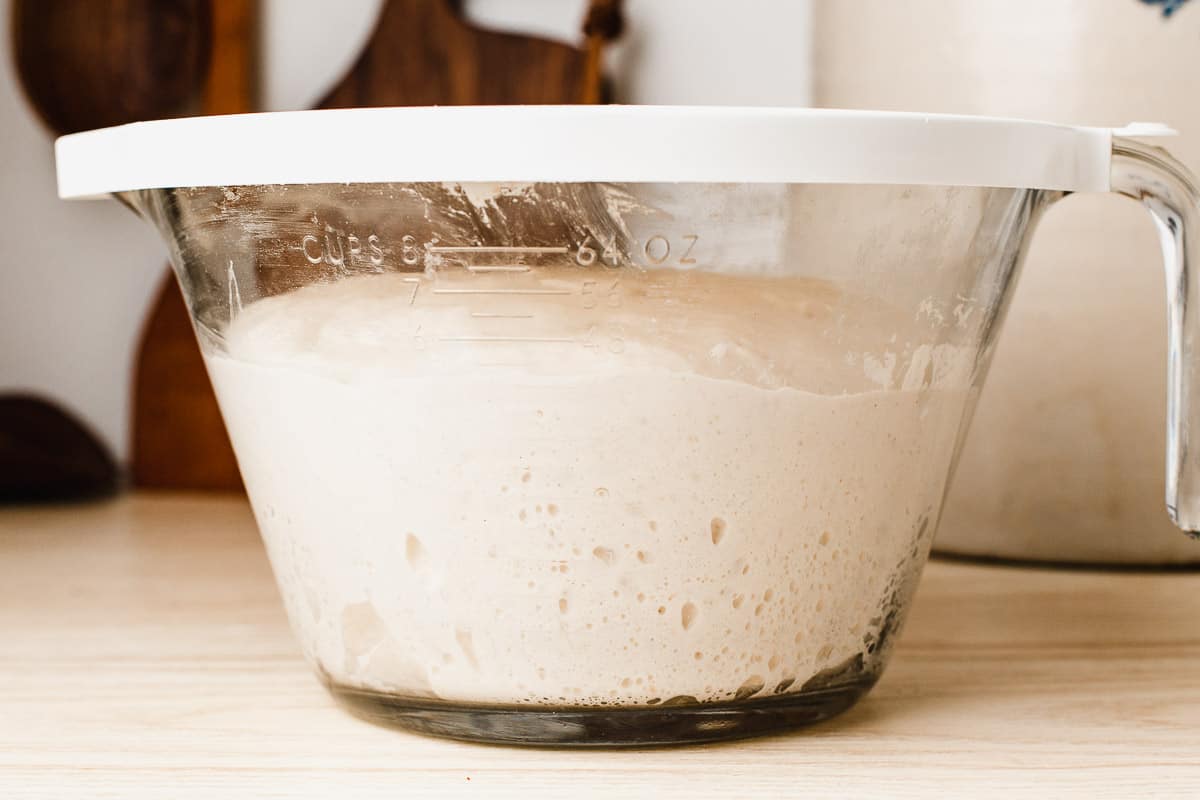
9:00 AM - Perform the third set of stretches and folds. Cover and rest at room temperature until the dough has risen by 50%. This can take 3-6 hours depending on the temperature of your kitchen.
12:00 PM - Transfer the dough to the fridge for a cold ferment, 8-36 hours. OR ...
NOTE: If you'd like to bake the same day, instead of a cold ferment in the fridge, divide and shape the rolls, let them rise until puffy and bake. (Because this is a high-hydration dough, it will be very sticky, so generously flour your work surface.)
8 to 36 hours later...
8:00 AM - Remove the dough from fridge. Flour your work surface and press the dough into a rectangular shape.
Use a bench scraper to divide the dough into 8 pieces and place them onto a parchment paper lined baking sheet.
NOTE: The dough can be sticky so do not be afraid to generously flour your work surface and the top of the dough when you go to divide and shape the rolls. Any extra flour on the dough can be brushed off after baking if desired.
Cover the dough with a kitchen towel and allow to rise until puffy, about 2 hours.
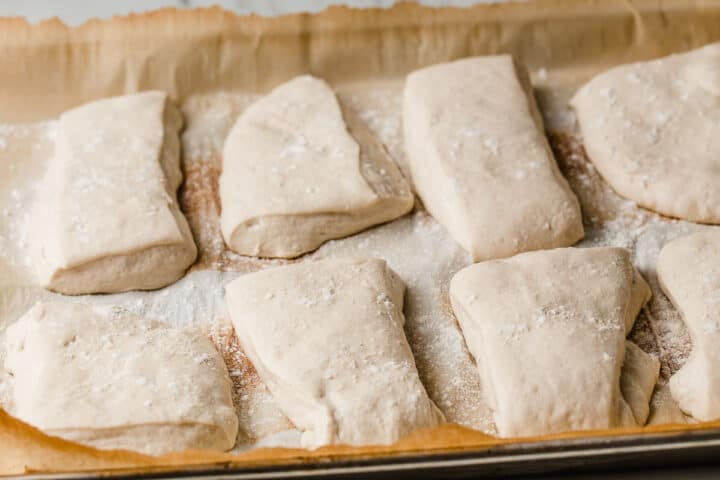
9:30 AM - Preheat your oven to 475°F (246°C).
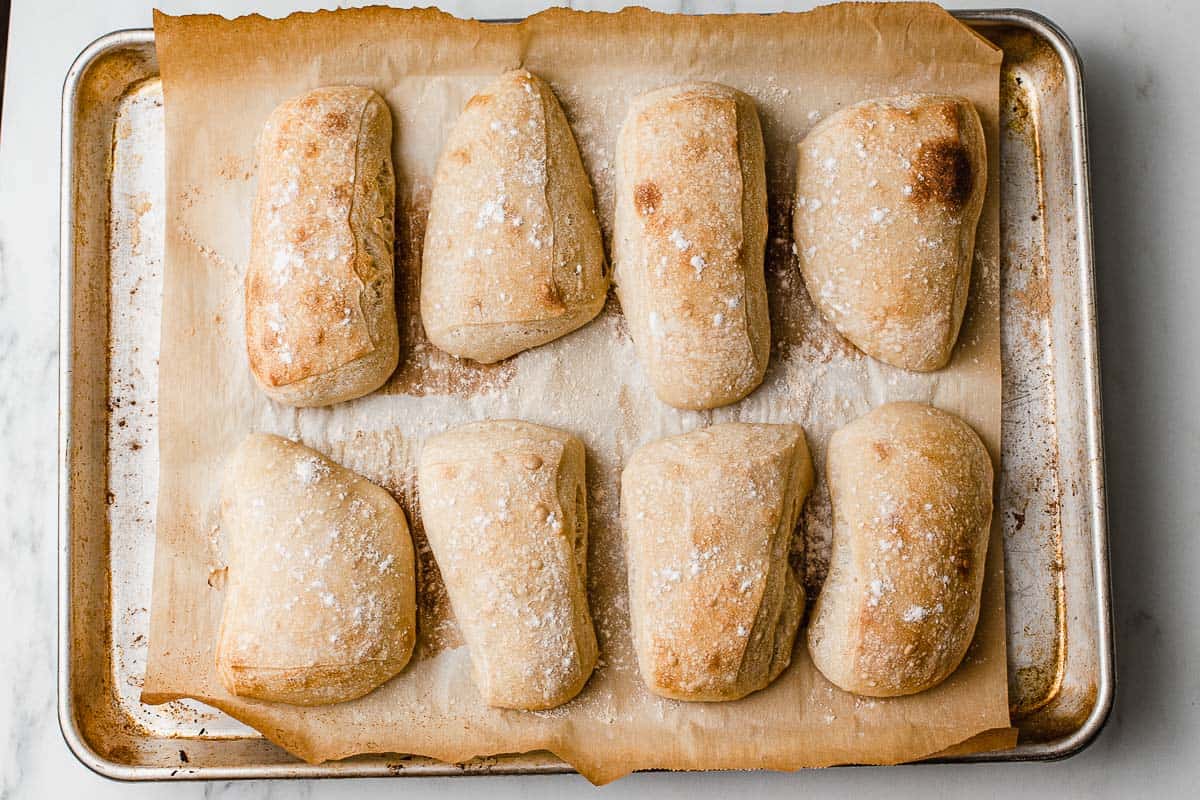
10:00 AM - Bake the rolls for 10 minutes. Turn the oven down to 425°F (218°C) and bake for an additional 20 minutes.
TIP: Allow the bread to cool down about 30 minutes before slicing to prevent it from being gummy inside.
Tips for success
Baking with a sourdough starter may seem a little overwhelming, but we want you to know that you CAN be successful! Here are some tips to keep in mind before you begin putting this sourdough ciabatta dough together.
How to calculate rising time
On our final testing for this recipe, our kitchen was 72°F (22°C) and it took 3 hours for our dough to rise to 50% in volume during the first rise at room temperature.
At 70°F (21°C) check around 3 ½ hours and at 68°F (20°C) check at around 4 hours.
These times will also depend on the strength of your sourdough starter. Please note that these times are only a rough estimate in order to help guide you through the process and not overproof the dough. Results will vary in EVERY kitchen.
Dividing and shaping the dough
This dough is considered a high-hydration dough because of the amount of water used. This type of dough can be hard to work with, especially if you are new to baking with sourdough.
This is one of the reasons we recommend dividing and shaping the dough while it's cold, as soon as you take it out of the fridge. When the dough is cold, it is firm, making it much easier to handle.
How to store and freeze
Keep the sourdough ciabatta rolls wrapped in a kitchen towel or in a bread bag at room temperature for up to 3 days.
If you'd like to freeze the rolls, place them into a freezer-safe container and keep in the freezer for up to 3 months.
More easy sourdough recipes
- sourdough hawaiian rolls
- sourdough sweet potato rolls
- beginners sourdough bread
- soft sourdough dinner rolls

Sourdough Ciabatta Rolls
INGREDIENTS
Ingredients to make ½ cup (100 g) of Active Sourdough Starter
- 1 tablespoon (15 g) sourdough starter
- ⅓ cup + 1 tablespoon (50 g) all-purpose flour
- 3 ½ tablespoons (50 g) water
Ciabatta Dough Ingredients
- ½ cup (100 g) active sourdough starter
- 4 cups + 2 tablespoons (500 g) bread flour
- 1 ⅔ cups (400 g) water
- 2 teaspoons (10 g) salt
INSTRUCTIONS
Feed Your Sourdough Starter
- 12 hours before you plan to mix the dough, add the ingredients to make ½ cup (100 g) of active sourdough starter to a clean jar. Stir until combined, loosely cover the jar and let the starter rise at room temperature. (The ingredients will create a total of 115 g active starter but, because some of it will stick to the sides of the jar during the transfer, we are making a little more than needed.) The sourdough starter is ready to use when it has doubled in size and there are plenty of bubbles on the surface and sides of the jar.
Make the Dough
- Mix the dough. Combine the active sourdough starter, bread flour, water and salt in a large mixing bowl. Use a stiff spatula or your hands to incorporate the ingredients, making sure there are no dry bits left in the bowl. Cover the bowl and let the dough rest at room temperature for 1 hour.
- Stretch and fold. Perform 3 sets of stretches and folds, 30 minutes apart. Keep the bowl covered in between each set.
- First rise. Cover the dish and allow the dough to rise about 50% in volume,. This can take anywhere from 3-6 hours at room temperature. Warm kitchens will take less time, cold kitchens will need more time. See notes for rising times.
- Second rise. Place the covered bowl of dough in the fridge for 8-36 hours for a long ferment OR proceed to the next step and shape the dough.
- Shape. Remove the dough from the fridge and generously flour your work surface before turning the dough out onto it. Flour the top of the dough and use your hands to form it into a rectangular shape. Be careful not to press the air from the dough. Cut the dough into 8 pieces and place them on a parchment lined baking sheet. Cover with a clean towel and allow the dough to rise at room temperature for 2 hours or until puffy.
- Bake. While the dough is resting, preheat your oven to 475°F (246°C). Bake the ciabatta dough for 10 minutes, turn the oven down to 425°F (218°C) and bake for an additional 20 minutes or until the crust is a deep golden brown. Allow the ciabatta bread to cool on a cooling rack for 30 minutes before slicing.

Made these last night. My husband loves ciabatta with chicken salad and cheese toasted in the broiler. I was hoping to pay a pic because they turned out perfect and delicious!
This ciabatta recipe is superb,as every other recipe I've made of yours.
In making these i realized higher hydration is where its at!
These rolls are so soft, yet withholds a nice chewy crust.
Thank you for sharing
Hi, I have these fermenting at the moment, I was doing it in my proofer at 25c but it was rising very fast, so I moved it to a room that is 22c. Would it have been ok to leave it in my proofer? Also, my dough was waaaay stickier than yours, so I weighed an additional 50g of flour, even now it is way stickier than yours, so i did a few extra stretch of folds during each of the three stretch and folds periods. I hope these few changes wont make much difference once they are cooked. I live in England and it is VERY WET here, raining almost constantly, so I weigh everything, however, I have noticed adding a bit more flour helps with my baking. I would love to hear your thoughts, I also have your bacon and cheese scones saved, you have a wonderful selection of recipes. Many thanks for sharing. Regards Jane
Absolutely beautiful ciabatta rolls, turned out great, I’m new to sourdough and I find myself being drawn to your recipes, clear instructions and videos make all the difference, I don’t like failure, so I read your posts over and over before I make recipes! Thank you so much!
I used about 40% wholewheat flour and added a little extra water to compensate, the second rise did not produce a rise, they just spread out a bit. I was careful not to degas when cutting them out as well. They baked ok with nice holes but were flatter than I hoped.
Love your recipes but these were definately my biggest challenge - maybe I'm just not ready for the high hydration but felt like I was working with a soupy mess the whole time! Any suggestions for next time? We LOVE your bagel recipe!!
Hi Jeanne, how warm is your kitchen?
I’ve made these probably 10 times now and they are perfect every single time, even when I need to adjust timing due to life. 10/10
They turned out PERFECT! Honestly, I have struggled so much with big holes! But this recipe was a winner! I did a 24-hour ferment in the fridge. So excited to make smashburgers with these! Thank you so much for sharing your recipe! -Carrie
I've made this recipe before and rolls are great. The high hydration is very sticky and a challenge to s&f. even as a puddle lift corners onto itself over and over around the bowl for about 5 min or more. On my second time I added 2 Tb flour and worked it in using bowl scraper just pushing onto itself, was a bit firmer. On 3rd s&f dough held together better but is definitely not like usual sourdough. Poured into cambro to bulk. Weighed with a scale. Hope this helps.
I’m so confused lol. I think I proofed them at too warm of a temp. I was in a rush so I put them at 78 degrees F for the last hour of proofing. Or maybe my hydration was off. They didn’t puff up on my second rise, but they spread a lot. After baking, they look weird. Very flat bottoms with domed tops that looked normal. But they were much flatter than expected and the top is much more crunchy than expected. Cut them open and the insides are gorgeous. I suppose it was my proofing method. I wish I could see a picture of yours from the bottom and a side view to compare to mine.
Can I sub in whole wheat bread flour for part of the dough recipe?
Hi Anne, yes you can but you may need to adjust the hydration a bit.
Anne, I have had great success with using 100% whole spelt flour*.
Two things:
1) The air holes will likely be smaller. Still super airy and fluffy with a nice crunchy crust, just not as big as pictured
2) I use 440 grams of whole spelt flour and add 50 grams of VWG and 10 grams of Organic Diastatic Malt Powder
Happy baking!