
Baking Conversion Chart

Want to make a sourdough recipe but don't have a kitchen scale on hand? No problem. Here is a handy dandy, baking conversion chart to make baking sourdough without a scale easy!
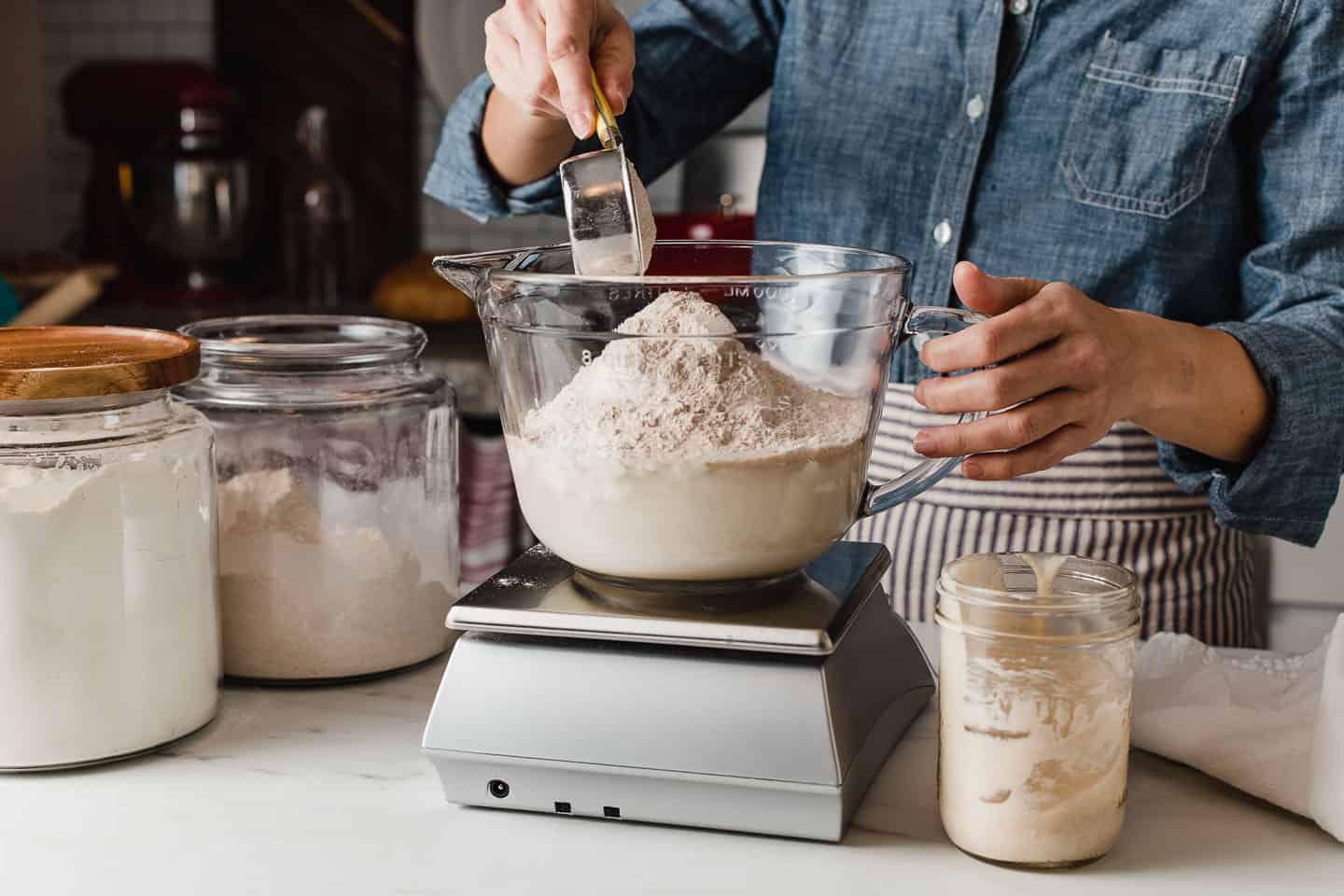
Use the scoop and level technique to measure your flour if you do not have a kitchen scale. As flour sits in a bag or canister it becomes more compact. You will need to fluff it up before measuring so that you don't end up with too much flour in your dough.
- Use a spoon to stir the flour while it is in its container.
- Scoop the flour into a measuring cup until it is heaped on top.
- Use a butterknife to level off the top.
This should give you the most accurate measurement of flour.
ACTIVE SOURDOUGH STARTER
- 50 g = ¼ cup
- 65 g = ⅓ cup
- 100 g = ½ cup
- 150 g = ¾ cup
SOURDOUGH DISCARD (UNFED)
- 10 g = 2 teaspoons
- 15 g = 1 tablespoon
- 62 g = ¼ cup
- 100 g = ⅓ cup
- 125 g = ½ cup
- 200 g = ⅔ cup
- 225g = ¾ cup
- 250 g = 1 cup
FLOUR (AP, Bread, and Whole Wheat)
- 40 g = ⅓ cup
- 50 g = ⅓ cup + tablespoon
- 60 g = ½ cup
- 90 g = ¾ cup
- 100 g = ¾ cups + 1 tablespoon
- 125 g = 1 cup + 1 teaspoon
- 200 g = 1 ⅔ cups
- 250 g = 2 cups + 2 teaspoons
- 300 g = 2 ½ cups
- 360 g = 3 cups
- 375 g = 3 cups + 2 tablespoons
- 400 g = 3 ⅓ cups
- 440 g = 3 ⅔ cups
- 450 g = 3 ¾ cups
- 480 g = 4 cups
- 500 g = 4 cups + 2 tablespoons
WATER/MILK
- 15 g = 1 tablespoon
- 250 g = 1 cup + 2 teaspoons
- 270 g = 1 cup + 2 tablespoons
- 300 g = 1 ¼ cups
- 325 g = 1 ⅓ cups + 1 teaspoon
- 350 g = 1 ⅓ cups + 2 tablespoons
- 360 g = 1 ½ cups
- 365 g = 1 ½ cups + 1teaspoon
- 375 g = 1 ½ cups + 1 tablespoon
- 390 g = 1 ½ cups + 2 tablespoons
- 400 g = 1 ⅔ cups
- 420 g = 1 ¾ cups
These measurements may vary from other baking conversion charts that you find, but they apply to all of the recipes on this website.
love sour dough
Sweet! Thanks! Does your sourdough include salt? Mine certainly does. A conversion for grams of salt to tsp would be helpful.
Curious as to why it can,t be printed ? I like to print out charts etc. and put them in a binder
Hi Sue, unfortunately we don't have it set up like that, but you can print out the webpage!
Do you have a printable copy of the conversion charts?
Thank-you
Once I have an active starter, how do I know how much to use and where are the baking instructions? I don’t see anything about actually baking the bread from this starter. Help! This is my first time! 🥺
Diane -
Go to our beginner sourdough bread recipe for the details!
Can you use Einkorn flour to make this low gluten?
Hi Julie, mostt recipes can be made with einkorn flour, however the amount of liquid typically needs to be much lower than the recipe calls for. Check out our einkorn sourdough bread recipe which has been tested and approved. Einkorn Sourdough Bread
found this great site while surfing Google.Thank you.my 1teaspoon flour mixed with 2 teaspoons Not chlorinated water ones a day turned out to be a beautiful active starter after 13 days.it's a dry cold starter on kitchen table and as soon as I have 120 grams of starter I shell bake my first braed and keep 20 grams to continue my starter.Oh,I am from sunny South Africa.
enjoy your baking.
I'm SOOOOOO happy with your recipe and conversion charts! I am 67 years old. I began with a simple starter and had so much difficulty following grams to cups and tablespoons as well as when to feed and when not to feed. You make it so simple and easy to follow. Thank-you!
You've got it all!! Even though I purchased a book on how to do this sourdough thing, before I knew about your site, I have used your smarts over and over. Your tips are so, SO, helpful. If not for all of your information, I probably would have thrown in the towel.The book was pretty much a waste, as far as "how to"....hoping there are some good recipes, at least. Thank you so so so much!!